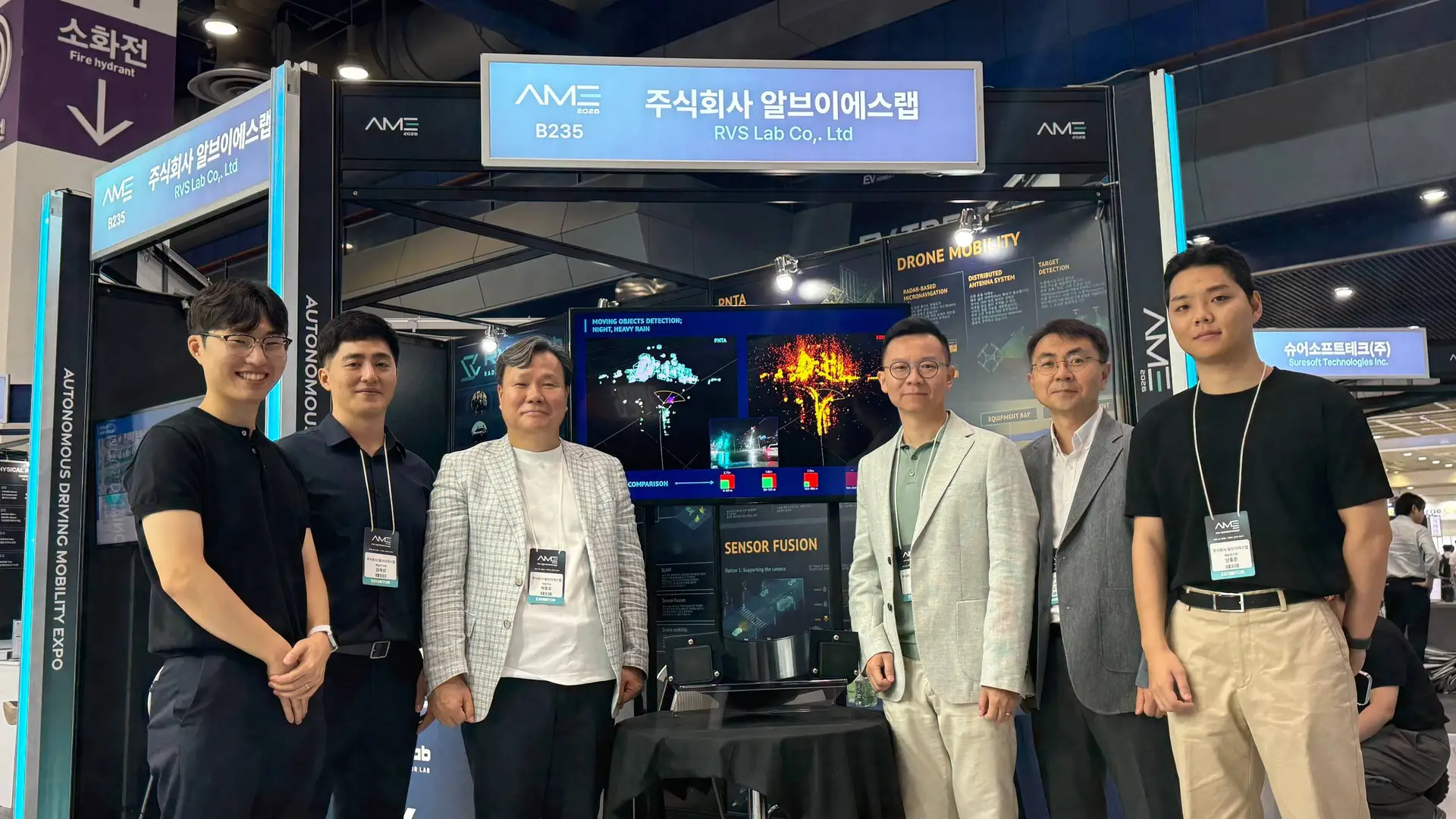
BRUGES, Belgium, September 3, 2026 — RVS Lab and CHUHANG Technology GmbH presented joint research at the 34th European Signal Processing Conference (EUSIPCO 2026), held August 31 to September 4 at Concertgebouw Brugge in Bruges, Belgium. The paper was presented in the special session on Radar and Multi-Modal Sensing for Perception and Localization in Intelligent Systems.
EUSIPCO is the flagship conference of the European Association for Signal Processing (EURASIP), an academic society founded in 1978. It is regarded as one of the most influential venues in the field, ranking alongside IEEE ICASSP as a principal forum for signal processing research in Europe and internationally.
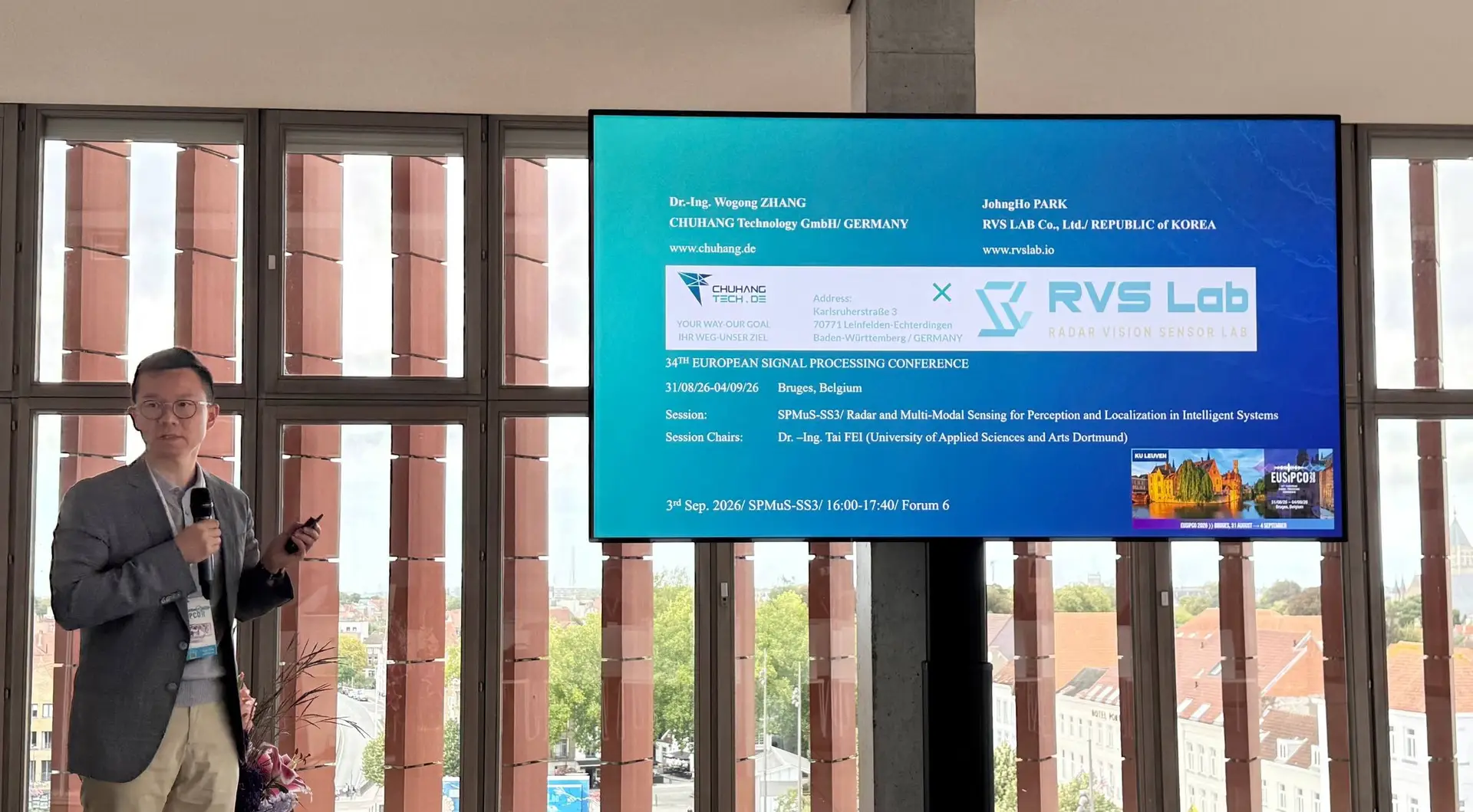
The paper, titled “Design and Verification of a Dual Satellite Radar Architecture for Automotive Application by using Probabilistic Nested Trajectory Analysis (PNTA),” examines what happens when two standard 4D MIMO imaging radars are combined with RVS Lab’s PNTA algorithm rather than treated as independent sensors.
Distributed satellite radar architectures have drawn growing interest from vehicle manufacturers, since multiple radar units feeding a central processing platform can extend coverage toward full environmental awareness. The joint work tested whether PNTA could raise the perception performance of such a configuration without changes to the radar hardware itself. Two 4D imaging radar modules, each with six transmitting and eight receiving channels, were mounted one meter apart on the roof of a test vehicle.
Algorithm Performance
On straight roads over 300 meters, the dual satellite configuration with PNTA showed a 3 to 6 times improvement in range resolution and a 3.5 to 9 times improvement in azimuth angular resolution compared with conventional MIMO processing. Gains were most pronounced at longer detection ranges.
Two automotive function tests followed. In a parallel parking slot search, PNTA identified an available slot at 91.8 meters, where conventional MIMO processing required approaching to 53.1 meters. In a driving-through judgment test, where the vehicle must decide whether a 2.2-meter gap between two obstacles is passable, PNTA reached a reliable decision at 85.8 meters against 37.8 meters for conventional processing.
The paper notes these figures represent qualitative trends rather than fixed performance values, since results vary with target radar cross-section, vehicle speed, and environmental conditions.

Reception at the conference
The presentation drew sustained questions from attendees, several of whom followed up with the presenter after the session. Treating a point cloud as a set of trajectories and progressively refining resolution along them remains an unfamiliar approach in the field, and the discussion suggested room for the concept to reach a wider audience.
EUSIPCO covers signal processing across audio, communications, image coding, and localization, drawing researchers from across these domains. For RVS Lab, the conference offered a venue to introduce PNTA to a signal processing community beyond the automotive radar field.
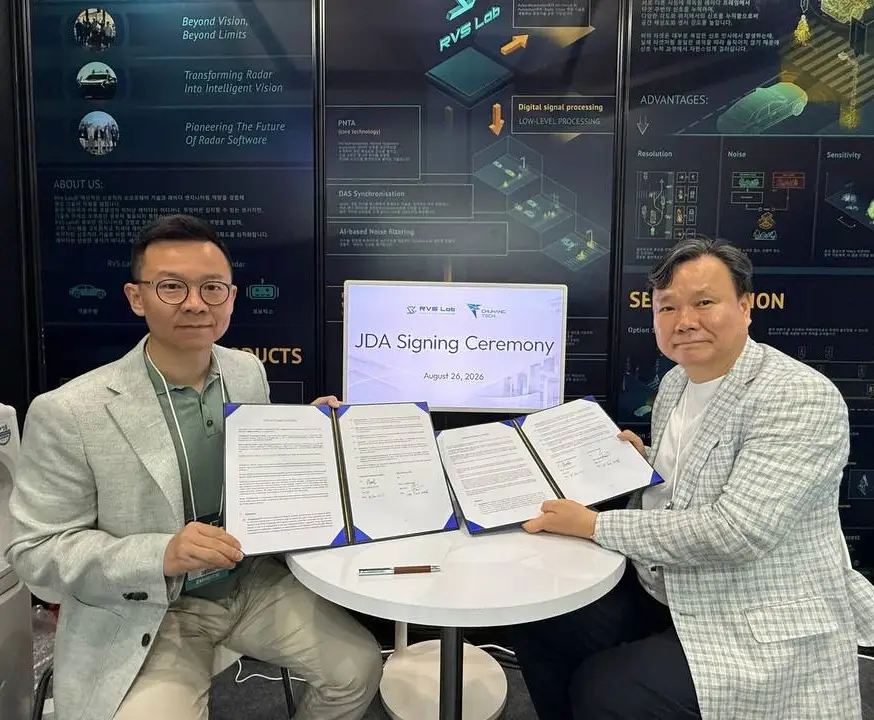
This marks the second joint publication between RVS Lab and CHUHANG Technology, following their paper at IWS 2026 in Shenzhen in May. The two companies signed a Joint Development Agreement in August to co-develop radar sensors for Level 3 and higher autonomy.